Buying Weakness and Selling Strength
by
Richard W. Miller, Ph.D.
01/04/10
TripleScreenMethod’s ApproachTSM’s stock trading strategy has been to identify weekly a group of 50 to 100 stocks that meet fundamental criteria (membership in at least 2 of 15 fundamental screens) and have value left in their current price. This grouping forms that week’s TSM Weekly Picks from which buys are forecast for the coming week. Each buy forecast aims to buy weakness and sell strength. This summary describes a very successful strategy designed to do just that.
Buying Weakness and Selling Strength: The Strategy
Larry Connors has thoroughly tested the Relative Strength Index, specifically the 2-period RSI, as a trigger both for entering and exiting stock and ETF trades. He’s developed strategies and tested them thoroughly over millions of historical trades, but he’s made no distinction with respect to a stock’s fundamentals, probably because it’s easier to test price than the array of fundamentals possible. In any case, I’ve explored the usefulness of these RSI(2) triggers for trading TSM stocks with their fundamentals and values.
The strategy is simple, just five rules:
· Stock has passed TSM’s fundamentals and value screening;
· Stock’s price is above its 200-day moving average;
· Stock’s daily RSI(2) has fallen below 15 for two consecutive days;
· Buy the Close (or near it) on the second day (or the Open of the next day);
· Sell the Close, the day when RSI(2) rises above 80 (a dynamic rather than static exit),
or again, at the Open of the next day.
Strategy’s Performance in 2008 and 2009
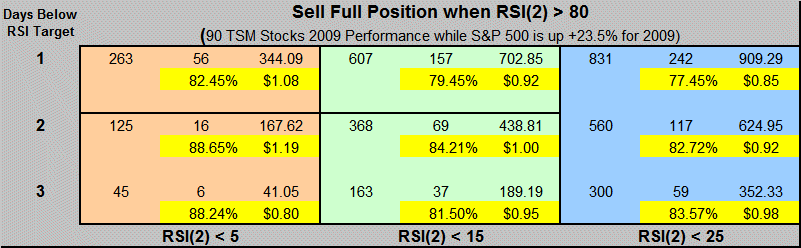
Let’s look first at 2009. It was a very good year for the market as evidenced by the 23.5 percent gain in the S&P 500. There were 90 unique TSM stocks forecast, many multiple times during the year which had 252 trading days. The following chart summarizes the trades that could have been made during the year for this set of stocks utilizing the above strategy (center statistics), as well as eight modified strategies (1 to 3 days below RSI(2) trigger and RSI(2) buy trigger from 5 to 25). These 90 stocks generated 368 winning, 69 losing trades and a 84.21 percent win rate to average a $1.00 gain per trade per share traded (438.81 total points gained over the year). Note, the statistics to the left and below each set are subsets of the primary strategy.
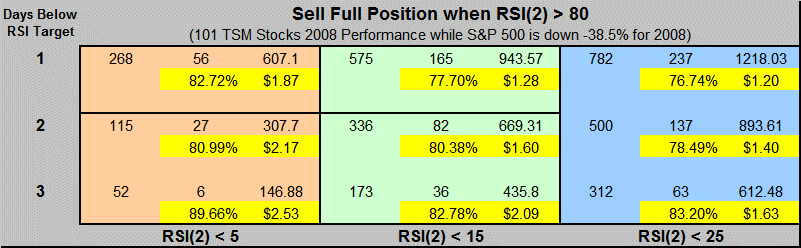
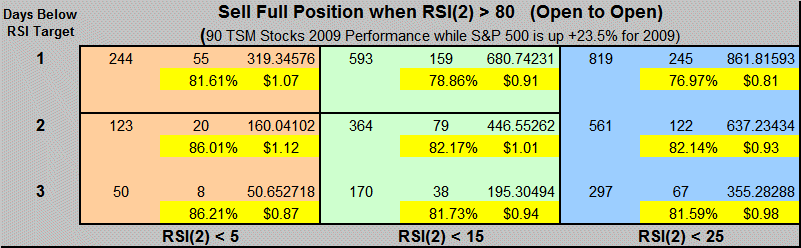
That’s all well and good for a good year in the market, but how did the strategy perform in 2008, a big down year for that market. As you can see in the following chart, the win rate dropped to 80.38 percent, but the average gain per trade per share increased to $1.60 and the total number of points gained likewise improved (to 669.31). Obviously, the strategy didn’t suffer.Now let’s look at the statistics generated when the buy and sell occurs at the opening at the next day instead of the close of the day the triggers signaled. Compare the data below to the first chart. While the win rate fell off a bit to 82.17 percent, the total points earned rose to 446.55. Not much difference for a strategy modification that allows one to set up trades in the evening rather than trying to catch each close.
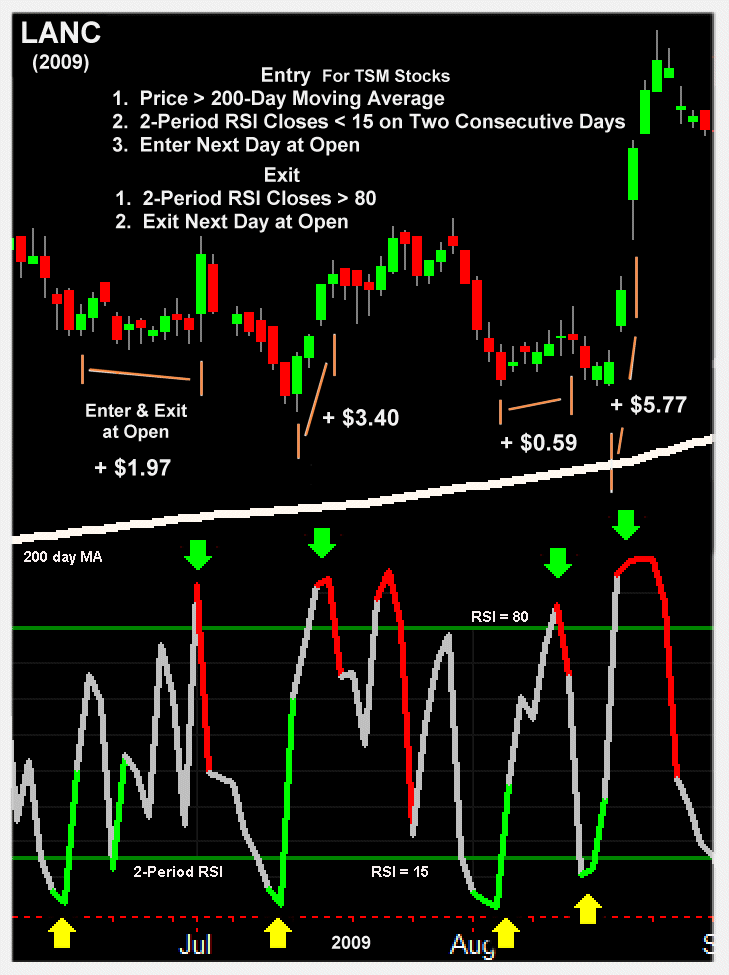
Finally, this last chart shows the Open-to-Open strategy in action. LANC generated nine trades in 2009, and eight were profitable. Four of the latter, covering a three-month period, are shown in the next chart. Arrows indicate entry and exit days on the RSI(2) chart, while vertical lines show the same thing on the chart itself. A 1,000 share trade for each of these trades would have generated $11,730 in profit. I’ll provide a more extensive assessment of this strategy and show how an option strategy utilizing Naked Puts might fit this strategy in a report I’ll issue soon.